
3K vs 12K Carbon Fiber for Freediving Fins: Key Differences
3K vs 12K Carbon Fiber for Freediving Fins: Key Differences

3K vs 12K Carbon Fiber for Freediving Fins: What’s the Difference?
When sourcing carbon fiber freediving fins, OEM buyers often come across two common weave specifications: 3K vs 12K carbon fiber.
Both can be used in carbon fiber fin construction, but they create a noticeably different surface appearance. More importantly, the choice between them should not be made simply by assuming that one is stronger, stiffer, or better than the other.
For diving brands, spearfishing equipment distributors, and private-label manufacturers, the more useful question is:
When should you choose 3K, and when does 12K make more sense for a carbon fiber fin product?
The answer depends largely on the desired appearance, graphic design, product positioning, and the overall construction of the blade.
This article explains the difference between 3K vs 12K carbon fiber for freediving fins, including how the choice can also apply to carbon fiber spearfishing fins.
For a broader overview of custom blade design, stiffness, materials, logo customization, and OEM manufacturing, see our Custom Carbon Fiber Freediving Fins: OEM & Logo Guide.
What Does 3K Mean in Carbon Fiber?
The “K” in carbon fiber terminology refers to the approximate number of individual carbon filaments in one tow.
3K means approximately 3,000 filaments per tow.
When these carbon fiber tows are woven into fabric, they create the familiar carbon fiber pattern seen on many composite products.
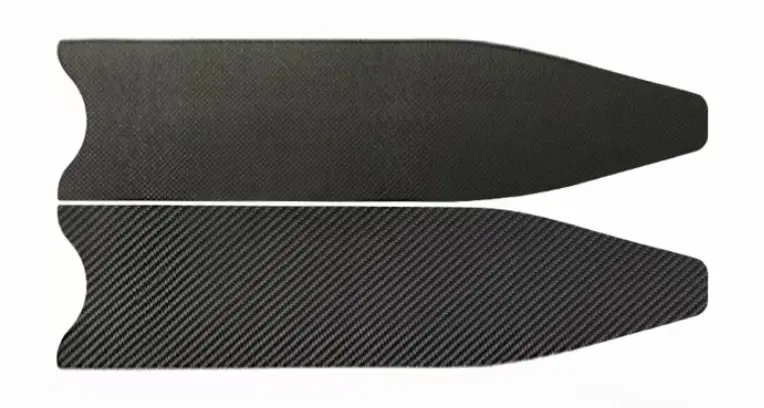
For carbon fiber fins, 3K fabric can be produced in different weave styles, including:
-
3K plain weave
-
3K twill weave
The result is a relatively fine and detailed carbon fiber pattern.
What Does 3K Carbon Fiber Look Like?
3K carbon fiber has a smaller weave pattern compared with 12K.
This makes it a practical choice for OEM fin products where the manufacturer or brand wants:
-
A traditional carbon fiber appearance
-
A relatively fine weave pattern
-
A clean technical look
-
A suitable background for custom graphics
-
A familiar appearance for carbon fiber sporting goods
For custom fin production, 3K is particularly useful when the carbon weave needs to work together with a larger graphic design.
This becomes important for full-graphic and camouflage carbon fiber fins, which we will discuss below.
What Does 12K Mean in Carbon Fiber?
12K means approximately 12,000 carbon filaments per tow.
Because each tow contains more filaments, the resulting woven pattern is larger and more visible than a typical 3K weave.
12K can also be produced in different weave styles, such as:
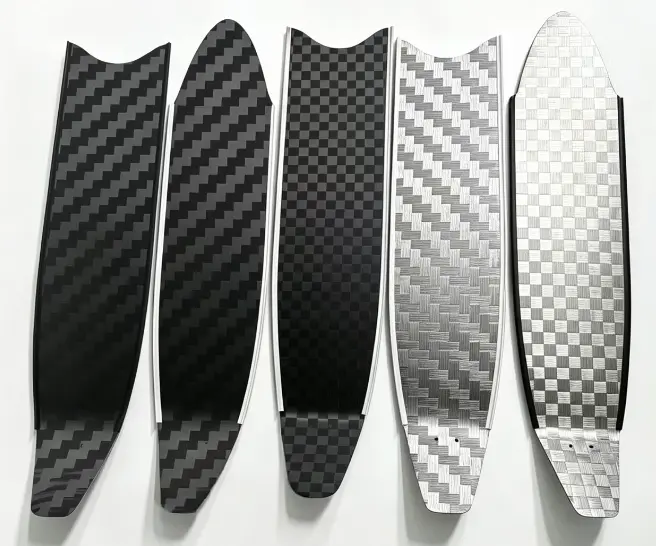
-12K black twill weave
-12K black plain weave
-12K silver twill weave
-12K silver plain weave
What Does 12K Carbon Fiber Look Like?
The main visual characteristic of 12K carbon fiber is its larger weave pattern.
Compared with 3K, the carbon pattern is easier to notice from a distance and can give the finished fin a more distinctive visual character.
For OEM brands, this can be useful when the carbon weave itself is intended to remain visible as part of the product design.
For example, a brand may choose 12K when it wants the carbon fiber pattern to be an obvious part of the finished blade rather than something largely covered by graphics.
3K vs 12K Carbon Fiber for Freediving Fins
The basic difference can be summarized as follows:
| Feature | 3K Carbon Fiber | 12K Carbon Fiber |
|---|---|---|
| Approx. filaments per tow | 3,000 | 12,000 |
| Visible weave | Smaller and finer | Larger and more pronounced |
| Visual character | Traditional carbon pattern | More distinctive larger pattern |
| Common weave options | Plain / Twill | Plain / Twill |
| Good for visible carbon patterns | Yes | Yes |
| Good for large graphic designs | Often practical | Depends on the design |
| Automatically stronger? | No | No |
| Automatically stiffer? | No | No |
The most important point is that 3K and 12K describe the carbon fiber tow size and resulting weave pattern. They should not be treated as direct stiffness ratings for the finished fin.
Does 12K Carbon Fiber Make a Fin Stiffer Than 3K?
Not necessarily.
The stiffness of a finished carbon fiber fin is determined by the overall composite construction rather than simply whether the visible fabric is 3K or 12K.
Depending on the fin design, factors can include:
-
Carbon fiber type
-
Fiber orientation
-
Number of layers
-
Laminate sequence
-
Reinforcement structure
-
Blade thickness
-
Blade geometry
-
Resin system
-
Manufacturing process
This means two blades can use different visible carbon weaves while having similar stiffness characteristics.
Likewise, two blades using the same 3K weave can be manufactured with different stiffness configurations.
For OEM buyers, 3K vs 12K should therefore be considered primarily as a material and appearance choice, while blade stiffness should be developed as part of the overall laminate and blade design.
For more information about stiffness selection, see our freediving fin blade stiffness guide.
3K or 12K: Which Is Better for Custom Fin Graphics?
This is where the choice becomes particularly relevant for OEM projects.
A carbon fiber fin can have a completely different appearance depending on how much of the carbon weave remains visible after graphics are applied.
For Full-Graphic Designs, 3K Is Often More Practical
In Foni Carbon Sports’ OEM projects, customers who choose full-graphic designs or large-area graphics generally tend to choose 3K carbon fiber.
The reason is straightforward:
When a large graphic covers most of the blade surface, much of the underlying carbon weave is no longer visible.
In this situation, choosing a more visually distinctive 12K weave as the base does not necessarily provide much additional visual value, because the graphic itself becomes the dominant design element.
For example, a custom blade may use:
-
A large brand graphic
-
Full-blade artwork
-
A large color pattern
-
Product-specific graphics
-
Camouflage artwork
With these designs, a finer 3K weave can provide a clean carbon fiber base without competing visually with the graphic.
What About Camouflage Spearfishing Fins?
This is particularly relevant to carbon fiber spearfishing fins.
Some customers are hunters who use their equipment for spearfishing or cray diving and want a camouflage appearance on the fin blades.
For these projects, the design may cover a large portion of the blade with camouflage graphics.
In this situation, using 12K simply to obtain a larger carbon weave pattern may not provide much practical benefit if the camouflage graphic subsequently covers most of that pattern.
Therefore, a 3K carbon fiber base is often a more practical choice for camouflage or large-area graphic spearfishing fins.
This does not mean that 12K cannot be used with camouflage graphics. It simply means that the additional visual effect of the larger 12K weave may be less noticeable once the graphic covers a substantial part of the surface.
When Does 12K Make More Sense?
12K can become more interesting when the carbon fiber weave itself is an important part of the visual design.
For example, an OEM brand may want:
-
A larger visible carbon pattern
-
A more distinctive weave appearance
-
Minimal graphics
-
A simple logo
-
A mostly exposed carbon fiber surface
-
A visually differentiated product design
In these situations, there is more reason to consider 12K because a greater portion of the weave remains visible on the finished blade.
For example, a relatively simple design with a small logo can allow the 12K carbon pattern to remain an important part of the overall appearance.
A Simple Way to Think About It
A useful rule for OEM product development is:
More visible carbon weave → 12K may be worth considering.
More surface graphics → 3K is often the more practical choice.
This is not a technical performance rule. It is mainly a product design consideration.
3K vs 12K for Carbon Fiber Spearfishing Fins
The same principle applies to carbon fiber spearfishing fins.
Spearfishing products can have very different visual requirements depending on the target market.
A minimalist carbon blade with a small logo may benefit from making the carbon weave part of the visual identity.
On the other hand, a spearfishing fin designed with camouflage graphics may have much less exposed carbon weave.
For example:
| Product Design | Potential Choice |
|---|---|
| Mostly exposed carbon surface | 3K or 12K |
| Small logo on carbon surface | 3K or 12K |
| Large brand graphics | 3K often practical |
| Full-blade graphics | 3K often practical |
| Camouflage spearfishing fins | 3K often practical |
| Simple design emphasizing large carbon weave | 12K may be considered |
| Product where weave is a major visual element | 12K may be considered |
The important consideration is not whether the product is specifically for freediving or spearfishing.
Instead, ask:
How much of the carbon weave will actually remain visible on the finished blade?
That question often provides a more useful starting point for selecting 3K or 12K.
Does 3K or 12K Determine the Strength of the Finished Fin?
The K designation alone is not enough to determine the mechanical performance of a finished carbon fiber fin.
For OEM development, the complete laminate should be considered.
Important variables include:
Carbon Fiber Grade
Different carbon fiber grades can have different mechanical characteristics. The fiber grade should therefore be evaluated separately from whether the fabric is 3K or 12K.
Fiber Orientation
The orientation of the fibers within the laminate affects how the composite responds to bending and other loads.
Laminate Structure
The number, sequence, and position of reinforcement layers contribute to the characteristics of the finished blade.
Blade Thickness and Geometry
Blade dimensions and geometry also affect how the blade bends and responds during use.
For this reason, 3K vs 12K is not an appropriate standalone specification for comparing the performance of two carbon fiber fins.
If you are comparing samples from different manufacturers, it is better to compare the complete fin specifications and, where possible, evaluate actual samples under the intended application conditions.
How Should an OEM Buyer Choose Between 3K and 12K?
For an OEM project, we recommend separating the decision into two stages.
Step 1: Define the Surface Design
First determine how much of the carbon fiber weave will remain visible.
Ask:
-
Is the blade mostly plain carbon?
-
Will there only be a small logo?
-
Is the design full-blade?
-
Will there be camouflage?
-
Does the brand want the carbon weave itself to be a major visual feature?
If the design will cover most of the blade, 3K is often a practical starting point.
If the weave will remain highly visible, 12K may be worth considering.
Step 2: Develop the Blade Construction Separately
Once the visual direction has been established, the technical construction should be considered separately.
This includes:
-
Carbon fiber grade
-
Layup structure
-
Fiber orientation
-
Blade thickness
-
Blade geometry
-
Target stiffness
-
Foot pocket configuration
-
Intended application
This approach prevents the common mistake of treating the visible carbon weave as the main factor determining fin performance.
What Should OEM Buyers Ask Their Carbon Fin Supplier?
When discussing a new carbon fiber fin project, it is useful to provide the supplier with both the visual requirements and the technical requirements.
For example, an OEM inquiry can include:
-
Do you offer both 3K and 12K carbon fiber?
-
Which weave styles are available?
-
Can the visible carbon weave be combined with custom graphics?
-
Can you produce full-graphic or camouflage designs?
-
What carbon fiber grades are available?
-
What stiffness configurations can you produce?
-
Can blade thickness and geometry be customized?
-
Can the foot pocket configuration be specified?
-
Can the logo and artwork be customized?
Providing this information early can help the manufacturer recommend a suitable combination of surface design and blade construction.
FAQ
Is 12K carbon fiber better than 3K for freediving fins?
Not automatically. 3K and 12K mainly describe the carbon fiber tow size and resulting weave appearance. The performance of the finished fin depends on its complete composite construction.
What is the main difference between 3K and 12K carbon fiber?
3K uses approximately 3,000 filaments per tow, while 12K uses approximately 12,000. As a result, 12K generally produces a larger and more visible weave pattern than 3K.
Does 12K carbon fiber make freediving fins stiffer?
Not by itself. Fin stiffness depends on the overall laminate structure, fiber orientation, reinforcement, thickness, geometry, and other construction factors.
Is 3K better for full-graphic carbon fiber fins?
For many OEM projects, 3K is a practical choice for full-graphic designs because large graphics cover much of the underlying carbon weave. In this situation, using a larger 12K pattern may provide less visible benefit.
Is 3K suitable for camouflage spearfishing fins?
Yes. For camouflage carbon fiber spearfishing fins, 3K can be a practical base weave because the camouflage graphic may cover a large portion of the carbon surface.
Can 12K be used for spearfishing fins?
Yes. 12K can be used when the larger carbon weave is intended to remain visible as part of the product’s appearance.
Can 3K and 12K both be customized with logos?
Yes. Both can be used for customized carbon fiber fin designs, including logos and graphic artwork, depending on the selected production and finishing method.
Should OEM buyers choose 3K or 12K based on strength?
No. The K number alone should not be used as a strength or stiffness rating. OEM buyers should evaluate the complete carbon fiber laminate and blade construction.
Conclusion
The difference between 3K and 12K carbon fiber for freediving fins is primarily related to tow size and the resulting weave appearance.
3K provides a finer carbon fiber pattern, while 12K creates a larger and more visible weave.
For OEM product development, however, the choice should not simply be based on the assumption that 12K is stronger or stiffer.
A more practical approach is to first consider how the finished blade will look.
If the product uses a mostly exposed carbon surface and the weave itself is an important part of the design, 12K may be worth considering.
If the blade uses full graphics, large-area artwork, or camouflage, 3K is often a practical choice because the graphic design will cover much of the underlying carbon weave.
This is especially relevant for carbon fiber spearfishing fins designed for hunters, spearfishing, or cray diving, where camouflage graphics may cover a substantial portion of the blade.
The final blade performance should then be developed separately through the appropriate carbon fiber grade, laminate structure, fiber orientation, thickness, geometry, and stiffness configuration.
Looking for a Custom Carbon Fiber Fin OEM Manufacturer?
Foni Carbon Sports supports OEM/ODM development of carbon fiber freediving fins and spearfishing fins, including carbon weave selection, blade geometry, stiffness configuration, logo and graphic customization, and product development.
If you already have a target design, logo, reference fin, camouflage artwork, or technical specification, contact us to discuss the appropriate carbon fiber construction for your project.